


Want to know the most effective way to crash the silver market? Forget naked short selling, dumping thousands of futures contracts or trying to overpower the buyers. There’s a much more elegant way to accomplish the same thing, and the beauty of it is that you can actually make a fortune on the way up. Simply help push silver to unsustainable levels, encourage the speculators to pile in, and then stand aside while the market crashes itself.
I raised this possibility when silver was going parabolic earlier this year. At the time, virtually everyone was talking about the enormous buying pressure, the structural silver deficit and the seemingly inevitable march toward $150 or even $200 an ounce. I was thinking about something entirely different. What if the people who wanted to profit from silver’s collapse were perfectly happy to help create the bubble that would eventually destroy it?
For readers who want to understand these market mechanisms before the next major turning point, I’m offering 35% off an annual Insider’s Advantage subscription. We follow the money, the leverage and the forces that can make markets behave irrationally. Join Insider’s Advantage here.
Silver Is a Small Town, and the Numbers Prove It
One of the most overlooked characteristics of silver is just how small the market really is. Compared with gold, copper, oil and other major commodities, silver is practically a neighborhood convenience store. It doesn’t require hundreds of billions of dollars changing hands to generate an extraordinary price movement. A relatively small amount of buying or selling, particularly in the futures market, can send prices into the stratosphere or straight into the toilet.
Consider the numbers. The Silver Institute forecasts approximately 1.05 billion ounces of total global silver supply for 2026. At $55 per ounce, that represents roughly $58 billion worth of newly supplied physical metal over an entire year. Compare that with the $555 billion value of annual gold demand reported by the World Gold Council for 2025, or the several hundred billion dollars represented by worldwide annual copper consumption at prevailing prices. These are comparisons of annual physical-market flows, not total above-ground inventories or financial trading volumes, but they illustrate just how small silver is relative to its much larger cousins.
And here’s another number that should get your attention. One standard COMEX silver futures contract represents 5,000 ounces, worth approximately $275,000 at $55 silver. A mere $10 movement in the price produces a $50,000 gain or loss on a single contract. Since futures traders can control that position with substantially less than its full value deposited as margin, enormous financial exposure can accumulate on a relatively modest capital base.
Now imagine what happens when thousands of those positions start moving in the same direction.
This is why I compare silver to a small town. Everybody knows everybody, who’s doing business with whom, who’s overextended and who’s likely to run into trouble. The major bullion banks, trading houses, hedge funds and commercial players understand the market’s positioning, delivery mechanisms and leverage far better than the average investor ever will. They don’t need to know every individual trader’s account to recognize when the market as a whole has become dangerously one-sided.
And when you’re dealing with a small town, a little trouble can spread awfully fast.
The Biggest Mistake Silver Investors Make About Manipulation
For decades precious metals investors have complained about downside manipulation, particularly concentrated short positions, naked short selling and those remarkable price collapses that seem to occur precisely when nobody is looking. There is certainly precedent for illegal conduct in precious metals trading. In September 2020, JPMorgan agreed to pay more than $920 million to resolve charges involving manipulation and spoofing in precious metals and Treasury markets. That wasn’t some imaginary conspiracy dreamed up by a guy sitting in his basement wearing a tinfoil hat. It was a federal enforcement action.
But here’s where I believe many silver investors have been looking at the problem backward.
Why assume manipulation or aggressive price engineering only takes place on the downside?
If you were a sophisticated trader looking to profit from an eventual collapse, why would you begin by fighting an extraordinarily powerful bull market? Why spend enormous amounts of capital trying to force the price down when you could participate in the advance and potentially profit from the very conditions that make the subsequent crash unavoidable? Let the speculators do the heavy lifting, encourage the excitement, and allow the price to reach levels that simply cannot be sustained.
The higher silver goes, the more vulnerable it becomes.
Every new record attracts another wave of buyers who missed the previous move. The financial media discovers another supposedly revolutionary reason why silver is destined to double. Momentum traders pile on, leverage expands, options activity increases and the people who couldn’t care less about silver six months earlier suddenly become experts on industrial shortages and monetary debasement.
The market starts feeding on itself.
Eventually, the fundamentals become almost irrelevant to the daily price action. Nobody is buying because silver is attractively priced relative to its historical valuation or long-term monetary importance. They’re buying because it’s going up, their neighbor made a fortune, and they don’t want to be the last idiot standing on the sidelines.
And that is when the market becomes most dangerous.
January 29, 2026: The Day Silver Ran Out of Oxygen
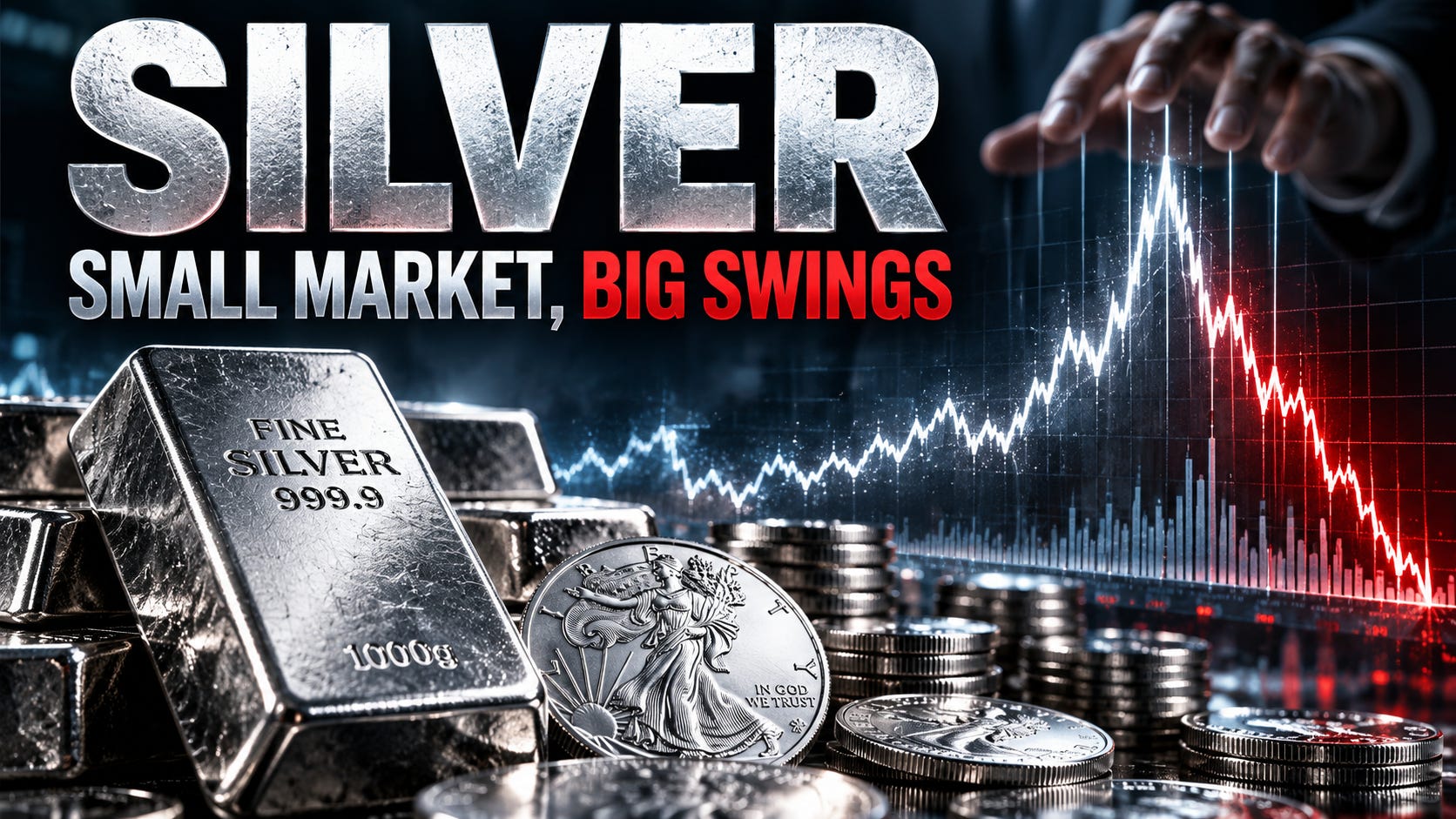
On January 29, silver reached an extraordinary all-time high of approximately $121.60 an ounce. The following day it suffered a historic collapse, losing more than 25% in one session, its worst single-day percentage performance in the available Reuters data going back to 1982. By February 2, silver had fallen to approximately $78, and the selling was far from finished.
Fast-forward to October 14, when silver traded around $55.50 following another vicious decline. That’s a loss of approximately 54% from the January peak. An investor who committed $100,000 near the high was now looking at a position worth roughly $46,000, assuming no leverage. Throw futures or borrowed money into the equation and the results could have been considerably worse.
Now I have a few questions.
Did the world’s industrial demand for silver suddenly disappear? Did Washington balance the federal budget, pay down the national debt and discover the virtues of sound money? Did central bankers around the world simultaneously decide that monetary debasement had become an unacceptable way to finance government spending?
Of course not.
Some things did change. Higher prices encouraged substitution and more efficient silver usage in solar manufacturing, while changing interest-rate expectations affected precious metals. The Silver Institute has forecast weaker industrial silver demand for 2026, even while expecting a sixth consecutive annual market deficit. Those are genuine fundamental developments, but they don’t adequately account for the extraordinary violence of a market that can lose more than half its value in less than nine months.
The explanation also lies in leverage, liquidity, speculation and the way financial markets respond when too many participants are positioned on the same side of a trade.
How You Crash a Market Without Having to Crash It Yourself
Imagine a silver market that has been rising for months. The early investors have enormous paper profits, the momentum traders are heavily committed, and the late arrivals are borrowing money to participate. Every new high reinforces the belief that the next high is just around the corner. The market’s apparent strength conceals an increasingly unstable foundation.
Then something changes.
Perhaps a major buyer stops buying, a large trader takes profits, margin requirements increase or a central banker says something that causes the dollar to strengthen. The precise catalyst may be relatively unimportant. What matters is that the initial decline triggers stop-loss orders, margin calls and automated selling, which in turn produce additional declines and more selling.
Before long, the market is doing an excellent job of destroying itself.
Think about the genius of this arrangement from the perspective of an operator who understands the mechanics. You don’t necessarily have to supply the enormous amount of selling needed to bring prices down. You simply need to recognize, or potentially help create, a situation where thousands of other traders are forced to sell for you. The very leverage that accelerated the advance now accelerates the collapse.
I’m not claiming to possess evidence that some secret committee of bullion bankers sat around a conference table and planned the January silver crash. That’s not necessary to understand my argument. Whether the boom was deliberately encouraged by sophisticated traders or developed through ordinary speculative excess, the resulting vulnerability was substantially the same.
A market that has been pushed far beyond sustainable levels doesn’t need much help collapsing. It has already been loaded with the financial equivalent of dynamite.
And the people who understand where the explosives are located have an enormous advantage over those who merely admire the fireworks.
The Evidence That Matters Before the Next Crash
This is where investors need to stop obsessing over predictions and start studying market behavior. An accelerating price advance accompanied by rapidly expanding speculative positions, rising leverage and increasingly emotional forecasts tells us something very different from an orderly bull market supported by patient accumulation. The price may be heading in the same direction in both cases, but the underlying structures are entirely different.
I pay particular attention to futures open interest, the CFTC’s Commitments of Traders reports, margin requirements, physical inventories and the relationship between paper prices and actual metal availability. None of these indicators can identify the exact top or bottom. Together, however, they can help reveal when a market is becoming dangerously crowded, when speculative enthusiasm is reaching unsustainable levels and when forced liquidation may be nearing exhaustion.
And those are the distinctions that can save investors a fortune.
Remember, a $10 move in silver represents $50,000 per standard COMEX contract. A trader holding ten contracts has half a million dollars riding on that seemingly modest price movement. When the market begins moving violently against heavily leveraged participants, they may have no choice but to liquidate, regardless of what they believe silver will be worth six months later.
That’s one reason I have always favored understanding the physical market as well as the futures market. A silver coin sitting in your safe isn’t going to generate a margin call because somebody at the Federal Reserve opened his mouth. You may experience a substantial decline in its market value, but you aren’t forced to sell simply because a broker demands additional collateral.
That distinction becomes particularly important when silver is behaving like a drunken sailor on shore leave.
What the Next Recovery Could Look Like
The remarkable thing about silver is that the same forces that make it so vulnerable to spectacular crashes also make it capable of extraordinary recoveries. A small market doesn’t require an enormous amount of fresh investment demand to experience major price appreciation. When speculative selling finally exhausts itself and buyers begin returning, the limited size of the market can once again work in investors’ favor.
But there is a substantial difference between recognizing long-term value and buying too early.
Silver could certainly fall further before finding a durable bottom. A market that has already declined by half isn’t obligated to stop simply because investors consider the price attractive. The important question is whether the speculative excess has been sufficiently removed, whether physical buyers are absorbing available supply and whether the underlying financial conditions are becoming favorable for another sustained advance.
I would much rather accumulate quality assets when the crowd is disgusted than chase them when everyone is celebrating. That applies to physical silver, properly valued mining companies and virtually every other investment market I’ve studied over the years. The greatest opportunities generally don’t arrive accompanied by television commentators congratulating you on your brilliant judgment.
They usually arrive when nobody wants to hear about the asset anymore.
And there is one more possibility worth considering. Just as sophisticated traders can benefit from excessive optimism on the way up, they can benefit from excessive pessimism on the way down. The people who were convinced that silver was cheap at $110 because it was going to $150 may eventually become convinced that it’s expensive at $55 because it’s going to $35.
That’s how markets transfer wealth from impatient investors to patient ones.
The Next Silver Fortune May Already Be Taking Shape
After watching financial markets for decades, I’ve come to believe that understanding the behavior of market participants is often more valuable than knowing everything about the underlying asset. You can memorize every silver supply statistic, study every mine in Mexico and calculate industrial consumption to the last ounce. And you can still lose a fortune if you don’t understand who owns the paper, how much leverage they’re carrying and what happens when they’re forced to sell.
The January silver explosion and subsequent collapse provided a rather expensive demonstration of that reality.
The long-term case for silver hasn’t disappeared, although its price was clearly carried far beyond what the market could sustain in January. Global debt continues to expand, governments remain dependent on deficit financing and silver retains important industrial and monetary characteristics. None of that guarantees an immediate recovery, but it means we should be examining the present decline for evidence of opportunity rather than automatically accepting the crowd’s latest pessimistic predictions.
I believe silver will eventually present another extraordinary opportunity. Whether that begins at $55, $50 or some lower level remains to be seen. What interests me is identifying the evidence of a durable change in market direction while most investors are still preoccupied with the wreckage of the last advance.
The biggest gains are often made by investors who prepare before the crowd changes its mind.
Don’t Be the Guy Who Bought at $120 and Panicked at $55
Think about what this year’s silver market has already taught us. Someone who bought near $120 because everybody was predicting $150 has watched more than half of his investment disappear. Someone who recognized the increasing speculative risk and preserved capital has an entirely different set of choices today.
The difference isn’t necessarily intelligence or access to some magical forecasting system. It’s understanding market structure, recognizing when prices have become detached from sustainable conditions and having the discipline to act accordingly.
That’s precisely why I created Insider’s Advantage.
I’ve spent decades analyzing financial markets, monetary policy, economic cycles and the incentives that drive people and institutions. Through the Financial Survival Network, I’ve conducted thousands of interviews with economists, investors, mining executives and market analysts. The objective has always been to understand what’s actually happening rather than simply repeat what the financial establishment wants everyone to believe.
With Insider’s Advantage, I take that analysis further. We examine the forces driving gold and silver, the positioning and monetary developments behind major moves, the opportunities in mining shares and the economic pressures that could produce the next major turning point. I want subscribers thinking about the next opportunity while everybody else is still talking about the last disaster.
An annual subscription is currently 35% off, bringing the regular $97 price down to approximately $63 for an entire year.
Join Insider’s Advantage Today and Claim Your 35% Discount
Consider what avoiding one disastrous purchase, recognizing one emerging opportunity or simply understanding the next major market reversal could be worth. That’s the sort of insight I work to provide, and at roughly $63 for a year, it’s a modest investment in becoming a much more informed investor.
Because in the silver market, the big money doesn’t always make its fortune by predicting the crash.
Sometimes it makes its fortune by helping create the boom that makes the crash inevitable.
And when that crash finally arrives, the people who understand the game may be the ones getting ready to make the next fortune.
Many of your points are valid but if you rely on the Silver Institute for unbiased market info to make decisions you may be in peril. They are constantly manipulating data to make appearances of growth slower than reality for silver
Also as long as you believe the real price of silver to be what ETF's pronounce it to be then the big bullion banks have you by the throat. They have shorted the market for so long with silver ETF's they stand to loose big time as the market climbs due to margin calls.
We will have a fair market when physical is demanded and the bullion banks cannot deliver. It seems only then, investors will no longer buy into the silver market price as real based on PAPER ETF's.
It would not surprise me, at that point if you then have a lower price for silver paper ETF's and higher prices for physical silver broken out into two components - AG 107 and AG 109.
Keep up the good work.
I wish you well.
The silver institute understated silver demand, not independent.