


A 125-year silence just came due in Venezuela. Here’s the part nobody on your feed is telling you — and why the same force that flattened Caracas is the one quietly repricing your portfolio.
Two minutes before seven on Wednesday evening, the ground under Venezuela did something it hadn’t done in over a century. A magnitude 7.2 foreshock, then forty seconds later a 7.5 mainshock — the strongest quake to hit the country in more than 125 years. Buildings in Caracas folded. The airport went dark. The casualty numbers started climbing and haven’t stopped.
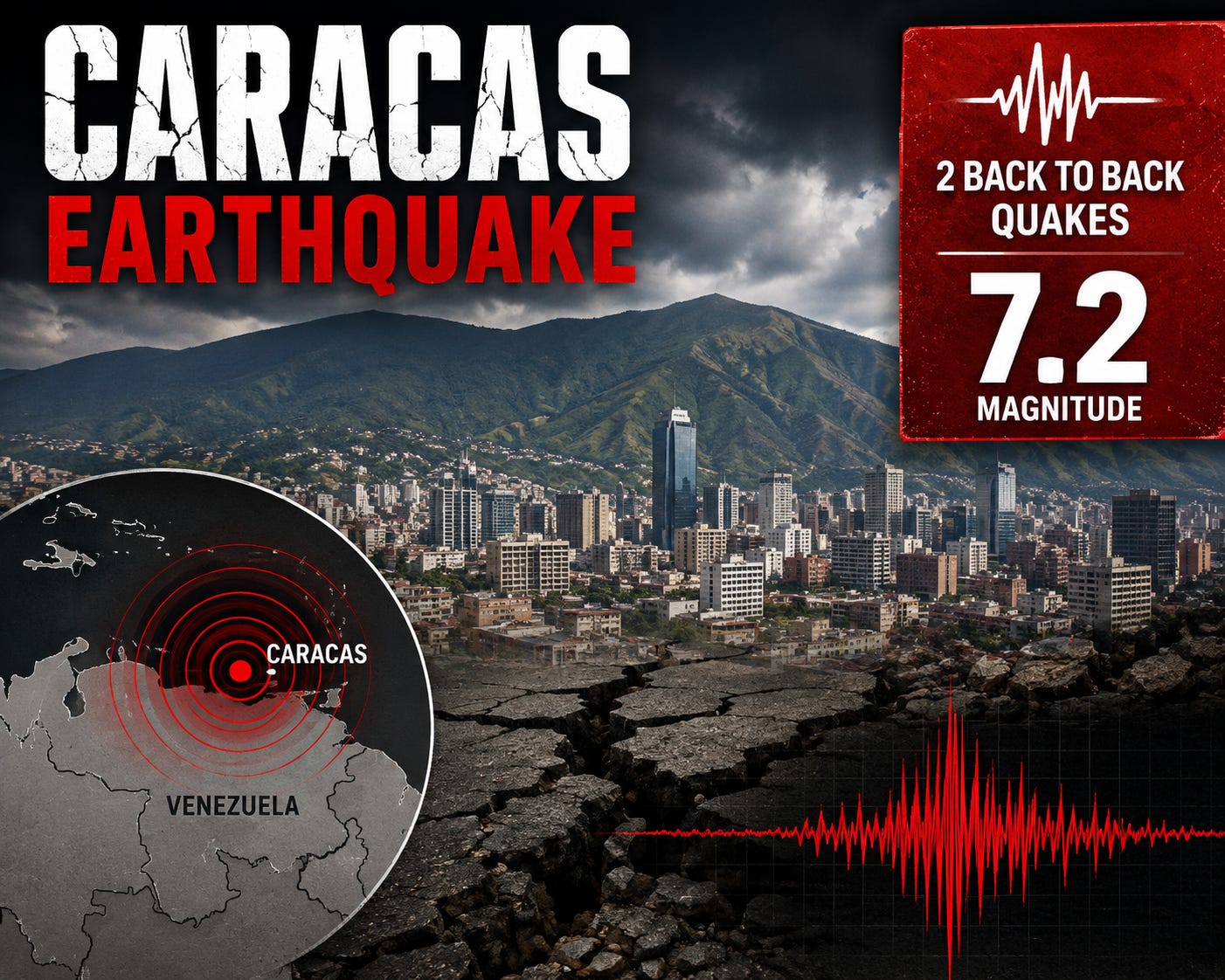
And the entire internet reached for the same word: catastrophe.
I want to take that word away from you. Not to be cold — there are families in that rubble and the grief is real. But because the word catastrophe hides the single most important thing these events have to teach, and the people who understand the hidden thing are the ones who don’t get buried by the next one. Financially or otherwise.
Here it is, the whole thesis in one line:
The earthquake doesn’t write the verdict. It audits the books.
A natural disaster almost never brings down a healthy system. It exposes and collects on fragility that was already sitting there, on the balance sheet, in the dark, accruing. The fault line is exogenous. The body count is endogenous. The Richter number belongs to nature — the death toll belongs to us.
You already know this is true, you’ve just never been handed the frame. The same magnitude-7 event kills a few hundred people in Japan and a few hundred thousand in Haiti. Same physics. Same energy release. Completely different outcome — and every bit of that difference was decided in the quiet decades before the shaking, in building codes, enforcement, maintenance, corruption, and slack. The quake didn’t cause the collapse. It called the loan on a structure that was already built insolvent.
This is the expert-witness move I make on every market call, applied to tectonics: don’t testify about the event. Testify about the condition the event revealed.
Whole civilizations have died this way — and the autopsy is always the same
Pull the thread and history backs you hard.
Everybody “knows” the volcano at Thera ended the Minoans around 1600 BCE. Except it didn’t — the Minoans hung on another century and a half. The eruption weakened them; the collapse came later, when something else pushed a structure that had already lost its slack.
The richest case is the Late Bronze Age Collapse around 1200 BCE, when an entire interlocking world — Mycenaeans, Hittites, Egyptians, the great trading hub of Ugarit — came apart almost at once under a stack of stressors including earthquake swarms, drought, and famine. And the lesson there is not “earthquakes are powerful.” The lesson is that those civilizations were tightly coupled. Bronze required tin and copper that only flowed through long trade networks, so every kingdom depended on all the others. The interconnection that made them rich became the wiring the collapse traveled down.
Read that twice, because it’s the whole game: efficiency in good times is contagion in bad times.
Now go look at modern just-in-time supply chains. Dollar plumbing. Cross-collateralized leverage. The same wiring. We didn’t escape the Bronze Age failure mode — we globalized it and added margin.
The vocabulary they never taught you (and Wall Street prays you never learn)
Three tools. Memorize them and you’ll never read a headline the same way.
Tainter’s ratchet. Complexity is a problem-solving strategy with diminishing returns. Societies keep bolting on bureaucracy, infrastructure, and specialization to solve problems — and each new layer costs more and buys less, until the system is so optimized it has zero slack left to absorb a shock an earlier, simpler version would have shrugged off. The disaster doesn’t have to get bigger. The society just quietly loses the ability to take a punch.
The turkey problem (Taleb). The turkey is fed every day for a thousand days and grows more confident each morning that the farmer loves him — right up until the Wednesday before Thanksgiving. 125 years without a major quake is not safety. It is the confidence interval widening on the turkey. Absence of recent disaster is the single most dangerous thing a system can mistake for resilience. That silence wasn’t protection. It was incubation.
The Seneca cliff (Bardi, channeling the Roman). Fortune is slow, but ruin is swift. Systems take centuries to build and weeks to fall, because fragility accumulates invisibly and then releases all at once. The chart of a collapse is not a symmetrical hill. It’s a gentle climb and a sheer drop.
You feel where this is going. Because I don’t write about tectonics. I write about capital. And the same three tools that explain why Caracas folded explain exactly what is about to happen to a regime ninety miles off the Florida coast — and what it does to the one asset I’ve been stacking, in physical form, while everyone laughed.
The free seats end here. Pull up a chair for the part that pays.
🔒 For subscribers: Same Force. Opposite Sign.
