


My New 32-Page Special Report on Weimar, Iran, Cuba, and Why America's Dollar Will Keep Losing Its Purchasing Power
I’ve spent more than 40 years practicing law, much of it handling defaulted loans and restructurings. I learned that when people owe more than they can pay, they generally have three choices. They can cut their spending, earn more money, or default. But governments have a fourth option that wasn’t available to any of my former clients. They can simply create more money.
And they have been doing it for at least 2,500 years.
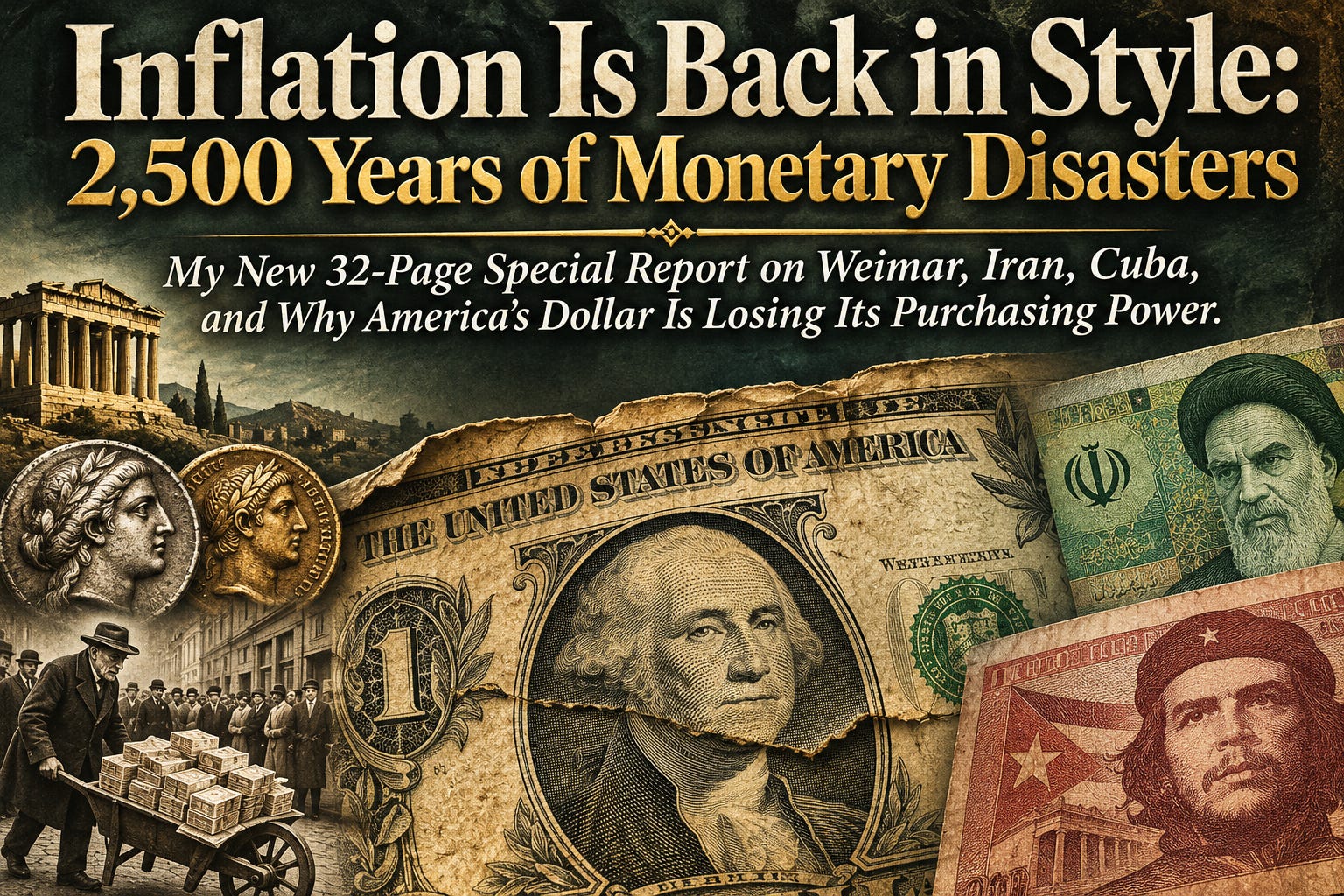
I’ve just completed what may be my most ambitious monetary research project to date. It’s called The Slow Theft: 2,500 Years of Inflation and Ten Modern Monetary Disasters, and I’m making the entire 32-page report available to Financial Survival Network readers at no charge.
We begin in ancient Athens, where the government discovered that copper coins could be made to look like silver. We move through Rome and the Byzantine Empire, where monetary debasement helped governments finance obligations they could no longer afford. Then we examine the Weimar Republic, where Germans watched a lifetime of savings disappear and the price of an ordinary loaf of bread eventually reach hundreds of billions of marks.
But this isn’t just ancient history.
Iran’s currency has lost more than 90% of its value against the dollar since 2020. Cuba recently introduced a 20,000-peso banknote that was worth approximately $28 on the informal market when it entered circulation. And Venezuela, Zimbabwe and numerous other countries have demonstrated what happens when governments lose control of their finances and their currencies.
Now consider what’s happening right here in America.
Washington just completed a fiscal year with a deficit approaching $2 trillion. Interest on the national debt has become a trillion-dollar annual expense. And the November midterm elections have given us a divided government in which Democrats and Republicans will disagree about almost everything, except apparently the need to spend money we don’t have.
The consequences won’t necessarily arrive as a spectacular financial collapse. The dollar remains the world’s dominant reserve currency, and there is still no obvious replacement. But that doesn’t prevent it from losing purchasing power year after year.
My baseline forecast calls for another 26.41% increase in consumer prices between December 2026 and December 2031. That’s without assuming a major military defeat, financial catastrophe or loss of the dollar’s reserve-currency status.
I explain the history, the monetary machinery and the economic forces behind my concerns in this special report. I’ve included extensive sources so readers can examine the evidence themselves.
Download Your Free Copy of The Slow Theft

Read it, save it and share it with anyone who still believes that a dollar is a permanent measure of wealth.
And What Happens Over the Next Five Years?
I’ve also prepared a separate 18-page Five-Year Dollar Forecast: 2027–2031, exclusively for paid Financial Survival Network subscribers.
Unlike most economic predictions, mine come with specific numbers and a permanent record. The paid edition includes my year-by-year inflation forecasts, what happens to $10,000 and $100,000 of purchasing power, three possible economic outcomes, and five developments that would force me to change my mind.
I’ll update the forecast quarterly and publish an annual scorecard comparing what I predicted with what actually happened. No moving the goalposts after the fact.
The Five-Year Dollar Forecast: 2027–2031

My Inflation Predictions for the Next Five Years — The Numbers, the Risks, and What Your Money Will Actually Buy
Special launch bonus: The first 35 readers who upgrade to an annual Financial Survival Network subscription will receive a complimentary Psyop Fashions Stop Central Bank Robbers Supima tee, while supplies last.

I’ve spent more than 15 years interviewing economists, investors and market experts on Financial Survival Network. If those thousands of conversations have taught me anything, it’s that governments are remarkably good at finding reasons to spend money, and remarkably bad at explaining who will ultimately pay for it.
The government can promise you a dollar. It cannot promise what that dollar will buy five years from now.
Below please find the complimentary report—The Slow Theft and below there is our Insider’s Advantage 5 Year Inflation Forecast.
Kerry Lutz
America’s Top Recovering Attorney®
Founder, Financial Survival Network
DollarTimeMachine.com