


Elon Musk May Have Broken the Most Important Rule of Capitalism
Rockefeller built an oil empire. Carnegie built a steel empire. Musk may be building the first empire whose most important product is the next empire. And he may be taking it to Mars.
When I was studying economics in college, we learned that there were certain fundamental laws governing the growth of companies. They weren’t quite as immutable as the laws of physics, but they were close enough. One of the most important was that no company, regardless of how innovative or successful it became, could continue growing at extraordinary rates indefinitely. Eventually, every company would hit a natural ceiling.
The reasoning was simple enough. A small company could double or triple its revenues because it was starting from a relatively small base. A midsize company could continue growing at impressive rates as it expanded into new markets and captured market share. But eventually the law of large numbers would catch up with it. If a company could grow exponentially forever, it would eventually own the entire world. And we knew that was impossible.
Every successful company eventually entered its mature phase. Growth slowed to single digits, much of it attributable to inflation, periodic price increases and modest productivity improvements. The company might still generate mountains of cash, but its days of explosive growth were behind it. That was the natural order of things, and nobody seriously questioned it.
Then along came Elon Musk.
Before we get into this, I’m bringing back my 35% Insider’s Advantage subscription discount. We’ve got three special reports coming out, and you’ll also receive five of my ebooks absolutely free. If you’re interested in recognizing the next great economic and investment opportunities before the crowd catches on, claim your 35% discount here.
Forget the Trillion Dollars. That’s the Least Interesting Part.
Everyone seems fascinated by Musk’s enormous fortune and the prospect of his becoming the world’s first trillionaire. Personally, I find that the least interesting part of the story. Musk doesn’t appear particularly interested in accumulating money for the sake of money anyway. Wealth is simply the fuel that allows him to pursue whatever seemingly impossible project happens to occupy his imagination.
What interests me is that Musk may have found a loophole in one of the most fundamental constraints on corporate growth. And if I’m right, the implications extend far beyond Tesla, SpaceX or his personal fortune. They could force us to rethink the entire concept of the corporate life cycle.
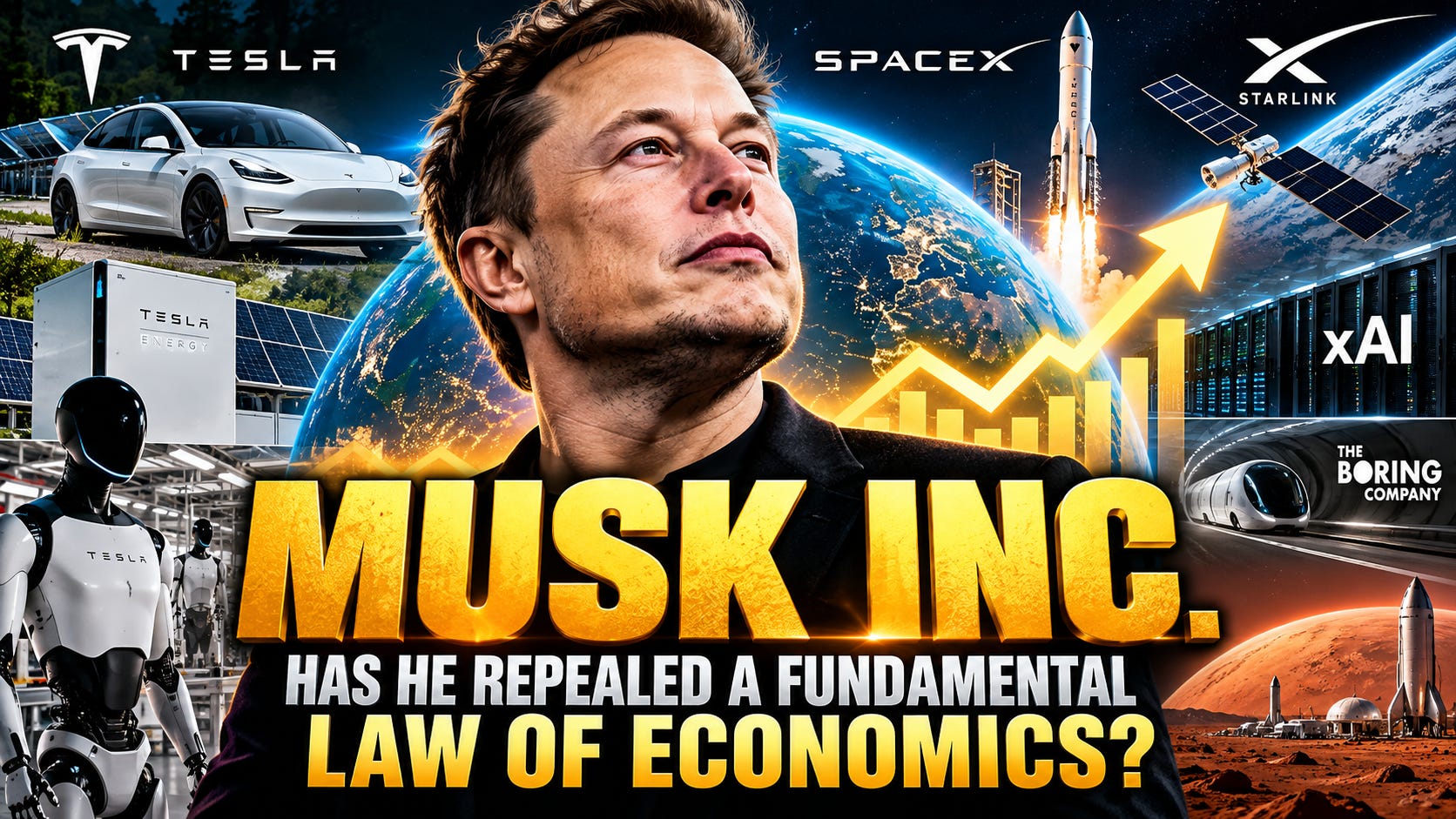
The mistake most analysts make is looking at each of Musk’s businesses separately. Tesla manufactures automobiles, batteries and energy storage systems. SpaceX launches rockets and develops Starship, while Starlink provides satellite internet and is expanding into mobile telecommunications. Tesla is developing autonomous vehicles and humanoid robots, xAI is building artificial intelligence systems, Neuralink is working on brain-computer interfaces, and The Boring Company is attempting to revolutionize underground transportation.
Then there’s X, the social media platform, and the increasingly close relationship between SpaceX and xAI. Musk’s businesses now touch an extraordinary range of industries that most people would never think to connect.
That’s the conventional way of looking at things, and I think it misses the point entirely.
What happens if we stop viewing these businesses as separate enterprises and instead combine them into one enormous economic organism? Let’s call it Musk Inc. Not because it’s a single conventional corporation, but because these businesses share something far more important than a common corporate parent. They share a founder who has repeatedly demonstrated an ability to transfer technology, engineering expertise, capital and talent across industries that most people regard as completely unrelated.
Most conglomerates acquire businesses and hope the combined enterprise will be worth more than the sum of its parts. Musk is doing something fundamentally different. He’s creating technologies that become the foundations of entirely new industries, and then using those industries to finance the next technological leap.
And that’s where things get interesting.
Rockefeller, Carnegie and Morgan All Hit the Wall
Consider the great industrial fortunes of American history. John D. Rockefeller built Standard Oil into one of the most powerful enterprises the world had ever seen. Andrew Carnegie dominated steel production, while J.P. Morgan assembled a financial empire that helped shape modern American capitalism. These men weren’t merely successful businessmen. They fundamentally changed the economic landscape.
But they all faced limitations. Rockefeller could only sell so much oil, Carnegie could only produce so much steel, and Morgan could only finance so many enterprises. They could expand geographically, consolidate competitors and improve efficiency, but eventually their growth became tied to the industries they dominated.
Rockefeller also encountered another obstacle. The federal government broke up Standard Oil in 1911. Washington wasn’t about to let one enterprise control the entire American oil industry.
Musk’s situation is different. He’s not simply trying to dominate one industry. He’s simultaneously attempting to disrupt a dozen of them, and in several cases he’s creating markets that barely existed a decade ago.
And just when you think he’s run out of industries to disrupt, he finds another one. SpaceX’s multibillion-dollar wireless-spectrum deal is positioning Starlink Mobile to challenge the traditional telecommunications giants. Think about that for a moment. A company that started out building rockets to reach space is now preparing to compete with AT&T, Verizon and T-Mobile.
The traditional growth model says you eventually run out of customers. Musk’s model seems to be that when you run out of customers, you find another industry with a few hundred million of them.
Tesla May Eventually Be Worth More for What It Doesn’t Manufacture
Here’s something that would have sounded ridiculous ten years ago. Tesla could eventually become far more valuable for what it does outside automobile manufacturing than for the cars themselves.
Consider autonomous transportation. Tesla has moved into Robotaxi services and is developing its purpose-built Cybercab. The technology still faces substantial regulatory, technical and competitive obstacles, but the potential business model is fundamentally different from selling automobiles.
When Tesla sells a car, it receives revenue from a transaction. If it operates a successful autonomous transportation network, it could potentially earn revenue every time that vehicle carries a passenger. The same physical asset could generate thousands of transactions over its useful life.
Now multiply that concept across millions of vehicles. Add software, fleet management, charging infrastructure and perhaps privately owned Teslas participating in a larger transportation network. Suddenly Tesla isn’t merely competing with Ford, General Motors and Toyota. It’s competing with Uber, Lyft, taxi operators and potentially large portions of the transportation industry.
And autonomous vehicles may be only the beginning. Tesla’s Optimus humanoid robot project is aimed at automating physical labor, a market that could eventually dwarf automobile manufacturing. If a commercially viable robot can perform useful work in factories, warehouses, farms, construction sites and homes, the potential applications are enormous.
Tesla doesn’t need to sell everyone a new automobile every three years to keep growing. It could develop entirely new sources of revenue from the intelligence, machines and infrastructure that make transportation and physical labor possible.
That’s a very different business from the one investors originally bought into.
The Secret May Be That Musk Keeps Resetting the Growth Clock
Here’s where I think my college economics professors may have gotten it wrong. They assumed a company would eventually exhaust its growth opportunities because its principal market would mature. And within the confines of a single industry, that assumption still makes perfect sense. There are only so many automobiles people can buy and so many satellite subscriptions they need.
But what if a company doesn’t remain confined to a single industry? What if the technologies it develops in one market give it an enormous advantage in entering another? And what if the second business creates the foundation for a third, fourth and fifth business?
Instead of one growth curve eventually flattening, you get a series of overlapping curves. The automobile business matures while energy storage accelerates. The rocket-launch business stabilizes while satellite communications expands. Artificial intelligence and robotics could eventually dwarf both.
We’ve already seen how different growth rates can coexist within Tesla. Its automotive business has faced pressure from competition and pricing, while energy storage has been expanding rapidly. One business can be slowing down while another is just getting started.
Musk Inc. doesn’t need every business to grow exponentially forever. It only needs to keep creating new growth engines faster than its existing ones mature.
That’s a very different proposition, and it may be the closest thing we’ve ever seen to a perpetual corporate growth machine.
The Factory That Manufactures Factories
This is where the story gets really interesting.
For most of industrial history, companies produced goods or services that were sold to customers. Rockefeller produced oil. Carnegie produced steel. Henry Ford produced automobiles. The profits could be reinvested to expand production or enter new markets, but the products themselves generally weren’t the means of creating entirely new industries.
Musk may be changing that relationship.
SpaceX develops reusable rockets that dramatically reduce the cost of reaching orbit. Those rockets make it economically feasible to deploy thousands of Starlink satellites. Starlink creates a global communications infrastructure, while artificial intelligence and robotics could eventually transform how rockets, satellites, vehicles and almost everything else are manufactured.
Follow that process to its logical conclusion. What happens when robots developed by one Musk enterprise begin manufacturing the products of another? What happens when artificial intelligence accelerates the design of the next generation of rockets, batteries, robots and computer systems?
We may be approaching a point where the output of one business becomes the principal means of production for the next business. Not merely another source of revenue, but the technological foundation for an entirely new enterprise.
Musk wouldn’t simply be creating a diversified conglomerate. He’d be creating an industrial ecosystem capable of accelerating its own expansion. Each successful business could increase the capabilities of the others while reducing the cost and time required to create the next generation of businesses.
It’s the difference between building a factory that manufactures automobiles and building a factory that manufactures factories.
And eventually, perhaps, factories that manufacture themselves.
And Then There’s Mars
So far, we’ve been discussing the growth opportunities available to Musk Inc. here on Earth. But Musk has never been particularly interested in limiting his ambitions to this planet.
His goal of establishing a self-sustaining human settlement on Mars may be the most audacious industrial undertaking in history. Forget for a moment about the engineering challenges and enormous costs. Think about what creating a functioning civilization on another planet would actually require.
You’d need transportation, energy production, communications, construction, food production, water extraction, manufacturing, medical facilities and eventually an entire industrial supply chain. You’d need autonomous machines capable of performing dangerous work where human labor would be extraordinarily scarce and expensive. You’d need many of the same technologies Musk’s companies are already developing.
SpaceX provides the transportation. Satellite communications could provide connectivity. Batteries and energy systems could contribute to power infrastructure, while robotics might eventually supply much of the labor. Artificial intelligence could coordinate complicated operations in an environment where waiting for instructions from Earth would be impractical.
Of course, none of this means a Martian settlement is commercially viable or even achievable on Musk’s preferred timetable. Starship still has enormous technical hurdles to overcome, and creating a self-sustaining settlement is a vastly greater challenge.
But here’s the part that fascinates me. Mars isn’t simply another destination for SpaceX rockets. It’s potentially the ultimate market for almost every technology Musk Inc. is developing.
Rockefeller wanted to dominate oil. Carnegie wanted to dominate steel. Musk wants to build a civilization on another planet.
Whatever you think of the man, you have to admit that’s a rather different business plan.
What About the Businesses We Don’t Even Know Exist?
There’s another element to this story that investors and economists may be overlooking. We’re analyzing Musk Inc. based on the businesses and projects he’s publicly disclosed. But what about the projects we don’t know about?
Would anyone have predicted fifteen years ago that a rocket manufacturer would become a serious competitor in global telecommunications? Would anyone have imagined that an electric automobile manufacturer would be developing humanoid robots and autonomous transportation networks?
I wouldn’t be surprised if Musk has another ten projects under development, or at least under serious consideration, that the public knows little or nothing about. That’s speculation on my part, but it would be consistent with his approach to business.
The next major growth engine of Musk Inc. may not even appear on anyone’s current list of Musk businesses. And that makes conventional financial analysis extraordinarily difficult.
How do you value an enterprise whose most important future business may not yet exist?
This is exactly the kind of economic transformation we’re following in the Insider’s Advantage. I’m bringing back the 35% subscription discount, with three special reports on the way and five of my ebooks included free. The biggest opportunities are often hiding in plain sight long before Wall Street figures them out. Reserve your discounted seat here.
But Has Musk Really Escaped the Law of Large Numbers?
Before we declare the old economics textbooks obsolete, there’s a problem with my theory. We need to distinguish between an enterprise’s economic potential and the actual growth of its revenues, profits and cash flow. Those are very different things.
Tesla isn’t immune to competition, pricing pressure or changing consumer demand. SpaceX and Starlink require enormous amounts of capital, while artificial intelligence is consuming money at a staggering rate. Robotics may prove revolutionary, but the difference between an impressive demonstration and a profitable mass-market business can be measured in years or even decades.
There’s also the question of whether Musk himself is the indispensable ingredient. His ability to identify opportunities, recruit exceptional engineers and tolerate levels of risk that would terrify conventional executives has been central to his success. But an economic empire that depends so heavily on one individual carries an obvious vulnerability.
And we shouldn’t confuse Musk’s personal holdings with a single consolidated company. The various enterprises have different ownership structures, investors and financial obligations. A breakthrough at SpaceX doesn’t automatically become a profit for Tesla shareholders, no matter how closely their technologies may be related.
There’s another historical warning worth remembering. General Electric once appeared capable of entering virtually any business and succeeding. Eventually, its complexity became a liability, and the supposedly indestructible conglomerate was broken into separate companies.
Musk could face the same fate. Or perhaps he’s developing something fundamentally different, where the common denominator isn’t financial ownership but technology itself.
The rockets enable the satellites. The satellites provide communications. Artificial intelligence improves the machines. The machines could eventually manufacture the next generation of products.
If that process becomes self-reinforcing, we may be witnessing an entirely new model of industrial capitalism.
Maybe Musk Didn’t Repeal the Law. Maybe He Found the Loophole.
I keep coming back to what we were taught in college. The economists weren’t fools, and the principles they explained weren’t wrong. Their mistake may have been assuming that the boundaries of a company would remain relatively fixed, and that growth would eventually be constrained by the size of its principal industry.
Musk has challenged that assumption more aggressively than almost anyone in modern business history. He doesn’t seem particularly interested in dominating the automobile industry and then settling into a comfortable existence collecting dividends. He wants to transform transportation, automate physical labor, develop artificial intelligence, revolutionize communications and establish a human civilization on Mars.
Some of those ambitions will fail. Others will take far longer and cost far more than he expects. And it’s entirely possible that Musk Inc. will eventually hit the same wall that stopped Rockefeller, Carnegie and Morgan.
But what if the natural ceiling on corporate growth isn’t primarily determined by the size of a company’s existing market? What if the real ceiling is management’s ability to continually identify, develop and commercialize entirely new technologies?
If that’s the case, Musk may have discovered something far more valuable than the formula for becoming a trillionaire. He may have discovered a way to keep resetting the corporate growth clock.
My college economics professors would probably insist that the old laws still apply. And technically, they’d be right. No company can grow exponentially forever within a finite economy.
But Musk may be testing a different proposition altogether.
Rockefeller built an oil empire. Carnegie built a steel empire. Morgan built a financial empire. Musk may be building the first empire whose most important product is the next empire.
And when he finally runs out of industries to conquer on Earth, he’s already working on another planet.
Maybe the economists were right after all. Every company eventually runs out of room to grow.
Elon Musk just decided to find more room.
The Next Great Economic Revolution Is Already Underway. Are You Positioned for It?
I’ve spent decades studying markets, monetary policy, financial crises and the economic forces that create and destroy fortunes. One lesson keeps coming back to me: the biggest opportunities rarely announce themselves in advance. By the time everyone agrees that a revolution is underway, much of the easy money has already been made.
That’s why I created the Insider’s Advantage. It’s where we go beyond the headlines to examine the trends, opportunities and dangers that could shape your financial future. Whether we’re talking about artificial intelligence, precious metals, government debt, currency debasement or the next major financial dislocation, my goal is to help you see what’s coming before the crowd catches on.
And right now, I’m bringing back a special offer.
Join the Insider’s Advantage and get:
35% off your subscription with my returning special offer.
Three upcoming special reports examining the economic and financial developments that matter most.
Five of my ebooks absolutely free as part of your membership.
My continuing analysis of the markets, the economy and the forces reshaping our financial world.
I’ve always believed that knowledge is only valuable when you can put it to work. You don’t need another financial newsletter telling you what happened yesterday. You need to understand what’s likely to happen tomorrow and why.
CLAIM YOUR 35% DISCOUNT AND JOIN THE INSIDER’S ADVANTAGE TODAY
The future isn’t waiting for anyone to catch up. I’m not and neither should you.

give him too much credit.. just another pon/face for the real puppeteer. name me any company that can be in the red for so long and somuch but keeps goingm endless cash really helps.