
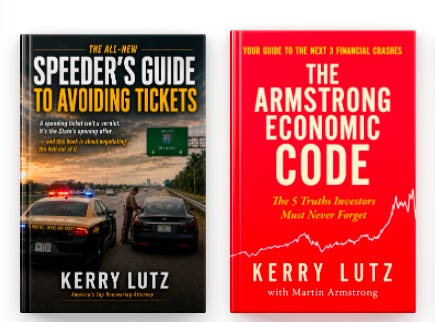
Why I wrote The All-New Speeder’s Guide to Avoiding Tickets — the origin story, the Speeding Industrial Complex, and how to grab a free copy (plus a second book on the house).
Let me start with the moment every driver knows in their bones.
You’re moving with traffic. Not weaving, not racing — just keeping pace on a highway built for speed. Then a maniac blows past you doing 95, threading lanes like he’s late for his own funeral. Two miles up the road there’s a trooper at the overpass. And when the lights come on, they’re not for the maniac. He’s long gone. They’re for you.
That’s the injustice this book was written for. The genuinely reckless driver almost always gets away. The person who actually gets stopped is the careful one who was driving with judgment the whole time — and now they’re being treated like the menace.
I wrote The All-New Speeder’s Guide to Avoiding Tickets for that driver. For you.
Where this really comes from
The philosophy in this book didn’t start with me. It started with my father.
First Lieutenant Nathaniel “Nat” Lutz flew the Hump in World War II — the deadliest air route of the war, hauling supplies over the Himalayas in weather and terrain that killed more men than the enemy did. Nat survived it because he refused to follow an order just because it was an order. He questioned what was underneath it. He made his own call. When the manual said one thing and his judgment said another, he trusted his judgment — and he lived.
He brought that home with him. Nat was a super speeder before anybody knew the term existed. Not reckless — disciplined. He had a code: never near homes, kids, schools, or blind driveways, but on the open highway he drove at the speed he believed was appropriate, and he was rarely wrong about it. He understood machines, he understood roads, and most of all he understood how the other side thinks.
That last part is the whole ballgame. And it’s the thread that runs through every page of this book. The tactics are downstream of the mindset: don’t accept the frame you’re handed at the roadside. Understand the system well enough to make your own quiet decision underneath it.
The Speeding Industrial Complex
Here’s the thing nobody in authority will say out loud: modern traffic enforcement stopped being mostly about safety a long time ago. It became a revenue machine.
Think about everything that feeds off a single speeding ticket. The municipality that books the fine. The court that adds surcharges and fees on top of the fine. The state points system that flags your license. The insurance company that uses those points to jack your premium for three to five years — often costing you far more than the ticket itself. The traffic schools. The “driver improvement” programs. The private contractors and camera vendors taking a cut. An entire ecosystem has grown up around the simple act of writing you up — and that ecosystem has a powerful financial incentive to keep the tickets flowing, whether or not the road is any safer for it.
I call it the Speeding Industrial Complex, and once you see it, you can’t unsee it. It’s not a conspiracy. It’s just incentives. And the incentives are not pointed in your favor.
Why this book is needed now
Because the machine just shifted into a higher gear.
Enforcement is hotter than it’s been in a generation. Here in Florida, the new Super Speeder law took effect in 2025 — and it doesn’t just raise fines, it criminalizes certain speeds, putting jail time and a permanent record on the table for things that were a civil headache eighteen months ago. The state logged hundreds of arrests under it within months, and the Highway Patrol is openly prioritizing corridors like I-95 and I-75. It’s a national wave: Georgia’s super-speeder surcharge, Virginia’s reckless thresholds, even proposals in California to bolt speed-limiter devices onto drivers.
And here’s what most people miss: when the troopers flood the highways hunting the triple-digit crowd, they don’t onlycatch the triple-digit crowd. The dragnet nets everybody. More cruisers, more stops, more ordinary 12-over tickets written to ordinary drivers. The headlines scream jail time, everybody’s scared, and the regular person — the one who was just keeping up with traffic — is more exposed than ever.
You need a way to handle the stop. That’s what this is.
I didn’t theorize this. I’ve lived it.
I’m a recovering attorney — a former New York commercial litigator with 40 years in the trenches — and I’ve been using the exact techniques in this book for decades.
The results speak for themselves. Using these methods, I’ve avoided the overwhelming majority of tickets I might otherwise have collected. And when I couldn’t avoid one, I beat a large number of them in court. This isn’t a collection of internet “10 quick tips.” It’s a field-tested system, refined over a lifetime, built on understanding the psychology of the encounter — what the officer is deciding before he even reaches your window, and how a calm, prepared driver quietly takes control of a situation he came to dominate.
At the heart of it is a simple framework I call A.D.M. — Admit, De-escalate, Mitigate. Three moves that disarm the stop before it ever becomes adversarial. There’s more inside — including the one quiet question that makes an officer unconsciously stop taking notes, so months later in court he has nothing to testify from. But A.D.M. is the spine.
Because remember: a speeding ticket isn’t a verdict. It’s the State’s opening offer. And this book is about negotiating the hell out of it.
Here’s my offer to you
I want you to have this book. Free.
Subscribe to Financial Survival Network, and I’ll send you a complimentary copy of The All-New Speeder’s Guide to Avoiding Tickets — and I’ll throw in The Armstrong Economic Code too, the Amazon bestseller I co-authored with the legendary Martin Armstrong, free as well. Two books, on the house, the moment you’re on the list.
You’ll also get everything else I publish: the market commentary, the geopolitical reads, the macro calls, and the occasional dispatch from the front lines of the various authorities I happen to be fighting at any given moment.
It’s a fair trade. You join the family, you get armed for the road and the markets.
👉 Subscribe below at the discounted anniversary rate and get both books instantly.
Drive smart. Keep your judgment. And never, ever accept the opening offer.
— Kerry Lutz America’s Top Recovering Attorney (and alleged habitual speeder)
The books are right below.
