


Forget the speeches and threats. If you want to know what the Pentagon is really thinking, follow the concrete.
I’ve always believed that if you want to understand what a government intends to do, you should spend less time listening to what its leaders say and more time watching where they put their money. Politicians make speeches, generals hold press conferences, and the media turns every military movement into the opening scene of World War III. But buried in the federal government’s contracting system is a document that may tell us more about Washington’s plans for Iran than anything President Trump has said in the past month.
On November 13, U.S. Army Central issued an urgent procurement notice seeking contractors to construct 17 reinforced-concrete military shelters across three Middle Eastern countries. Ten are planned for one installation in Israel, five for two locations in Saudi Arabia, and two for separate locations in Lebanon. Contractors have until November 25 to express interest, with an anticipated three-day turnaround for price quotations and completion required within 45 days of a construction order. For an organization that can spend six months deciding which brand of office chair to buy, that’s moving at the speed of light.
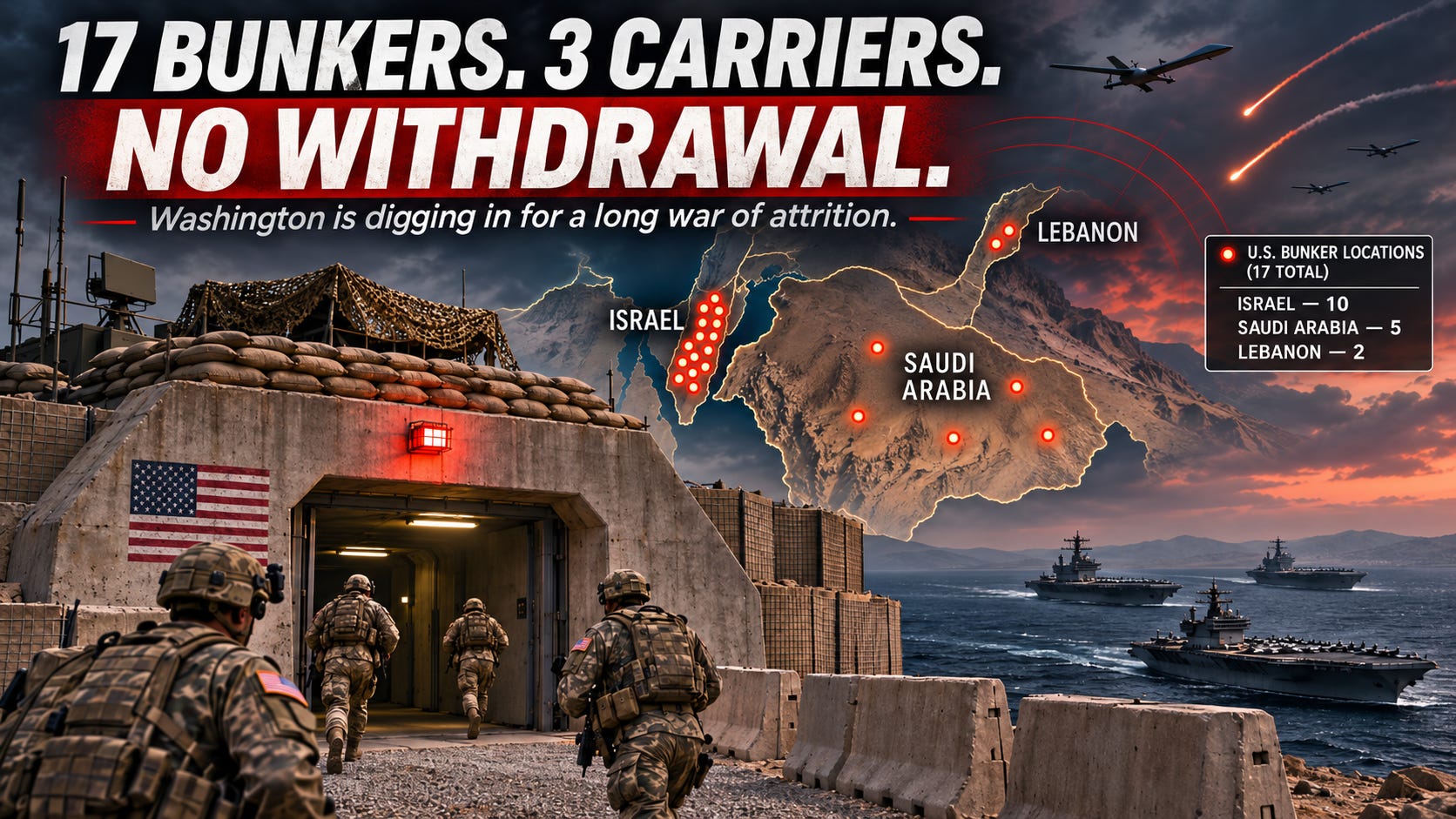
The actual Army notice is publicly available. It’s an initial request to identify qualified contractors, not an announcement that the construction contracts have already been awarded. But the requirements are unusually specific, and the urgency is unmistakable. The Army wants these shelters built because American and allied military personnel are still using converted shipping containers for protection against Iranian missiles, drones, and other incoming fire. Apparently, someone at the Pentagon finally discovered that a shipping container makes a lousy bomb shelter.
Unfortunately, it took a tragedy to drive that point home. In March, six American service members were killed when an Iranian drone struck a makeshift command facility at Kuwait’s Port of Shuaiba. The building provided inadequate protection against an overhead attack. The Pentagon has now reported 23 American military deaths associated with the Iran war, including 11 from enemy action and 12 from accidents and other noncombat causes. Whatever one’s opinion of the war, losing soldiers because they were housed in structures never designed to withstand an attack is a failure of military planning.
The proposed replacement shelters aren’t elaborate underground fortresses. They’re standardized concrete structures assembled from precast sections, fitted with steel doors, protected at their entrances by blast barriers, and covered with additional sandbags. The specifications call for at least 18 inches of sandbag protection over the roofs. The idea is to give troops somewhere substantially safer to run when the warning sirens sound. Nothing is indestructible, but there’s a considerable difference between hiding behind reinforced concrete and hiding inside something originally designed to transport furniture across the Pacific.
Here’s an interesting point. Israel is probably the last country on earth that needs lessons from the United States about building bomb shelters. The Israelis have spent decades developing hardened military installations, underground command facilities, and reinforced civilian safe rooms. Protecting people from rockets and missiles is practically a national industry. So why is the U.S. Army issuing an emergency construction notice for ten concrete shelters inside Israel?
The answer isn’t that Washington intends to ship American cement mixers to the Negev Desert. The procurement calls for contractors capable of mobilizing locally across Israel, Saudi Arabia, and Lebanon. Israeli companies are perfectly capable of doing the work. The Pentagon, however, has its own personnel, facilities, specifications, and contracting requirements to satisfy. It wants American military protection built to its standards, whether the people pouring the concrete speak English, Hebrew, or Arabic.
But there’s another aspect worth considering. This entire procurement exercise is taking place in public. Anyone with an internet connection can read it, including the Iranian military and its intelligence services. It’s possible that this is simply the unavoidable bureaucracy of federal contracting. It’s also possible that Washington doesn’t particularly mind Tehran knowing that American forces are strengthening their positions throughout the region.
Either way, the message is hard to miss. We’re not packing up and going home.
Now put that together with the arrival of the USS Theodore Roosevelt in the Middle East on November 15. The Roosevelt joins two other American aircraft carrier strike groups already operating in the region. Three carrier groups, accompanied by an assortment of destroyers and other warships, represent an enormous concentration of American air and naval firepower. They give Washington the ability to sustain a blockade, defend regional positions, and launch additional strikes without sending a massive American ground army into Iran.
And that’s the distinction I believe much of the mainstream reporting is missing. The media sees three aircraft carriers and immediately starts speculating about the next gigantic bombing campaign. The emergency bunker construction gets interpreted as further evidence that a massive assault is imminent. Perhaps another round of strikes will come. Nobody outside the highest levels of government knows for certain. But the combination of carrier deployments and fortified military positions suggests something potentially more consequential than a spectacular two-week campaign.
It suggests Washington is preparing for a prolonged war of economic and military attrition.
I’ve discussed this strategy before. You don’t necessarily have to invade a country and occupy its capital to defeat its government. Sometimes you can accomplish the same objective by depriving it of the money, fuel, equipment, and international commerce it needs to function. Iran is particularly vulnerable because its government depends heavily on energy revenue, while its economy has been battered by sanctions, inflation, currency depreciation, infrastructure damage, and now an American naval blockade.
The numbers are already ugly. By September, the Iranian rial had fallen beyond 2.3 million to the dollar, while inflation was running above 80 percent. The blockade has restricted oil exports and deprived the government of desperately needed foreign currency. Now winter is approaching, and damage to natural gas infrastructure threatens additional shortages. Tehran can manufacture more rials with the push of a button, but it can’t manufacture foreign currency, replacement industrial equipment, or the energy infrastructure necessary to keep its economy operating.
That’s how economic warfare works. You don’t have to destroy every factory or oil terminal. You just have to make it increasingly difficult for the country to finance, maintain, and operate them. Eventually, the economic damage spreads far beyond the original targets. Businesses close, unemployment rises, essential goods become scarce, and the government finds itself spending more resources maintaining control over an increasingly desperate population.
There’s also pressure coming from inside Iran. In the southeastern province of Sistan and Baluchestan, armed opposition groups have been consolidating their operations. Just last week, Ansar al-Furqan announced that it was joining the Jebhe-ye Mobarezin-e Mardomi coalition, commonly known as JMM. Iranian Kurdish opposition groups have also organized politically in the northwest. None of this establishes that Washington is directing these movements, or that they possess the capability to overthrow Tehran. But it adds another layer of pressure to a government already facing enormous external difficulties.
This is where my receivership analogy comes into play. In a corporate receivership, the people who control the assets, cash flow, and access to financing can exercise enormous power without necessarily controlling every employee or every office. Governments aren’t corporations, and military blockades aren’t court-appointed receiverships. Nevertheless, the underlying principle is remarkably similar. Control the revenue, restrict access to essential resources, and force the other side to operate under increasingly difficult financial circumstances.
Of course, there’s one enormous problem with this strategy. A financially strangled government still has missiles, drones, and the ability to strike back. In fact, the more threatened Tehran’s leadership feels, the greater the danger that it will use whatever military capabilities remain available. A government that believes it’s fighting for its survival isn’t necessarily going to behave rationally, particularly when compromise could be interpreted internally as surrender.
That brings us right back to those 17 bunkers.
If Washington intends to maintain a long-term blockade and military pressure campaign, it needs its personnel and regional infrastructure to survive the inevitable retaliation. Iranian drones are relatively inexpensive, can be deployed in large numbers, and have already demonstrated their ability to inflict casualties and damage expensive military equipment. America can afford to replace a concrete shelter. What the administration cannot easily afford is a continuing stream of American casualties, particularly after an election in which the war’s economic and political costs were already weighing on voters.
So the military is doing what it should have done months ago. It’s strengthening the positions most vulnerable to attack. The shelters won’t eliminate casualties or make American bases invulnerable, but they can reduce the damage from smaller attacks and nearby explosions. More importantly, better protected bases give Washington greater freedom to maintain pressure without every incoming drone becoming a potential political catastrophe.
There’s a reason this matters to investors as well. A prolonged confrontation involving Iran isn’t merely a military story. It’s an oil story, a shipping story, an inflation story, and ultimately a monetary story. If the Strait of Hormuz remains disrupted, energy markets will continue carrying a substantial geopolitical risk premium. Higher transportation and energy costs work their way through the global economy, and central banks already struggling to balance inflation against weakening economic growth have another variable they can’t control.
We could be looking at a confrontation in which Washington has little incentive to withdraw, Tehran has limited ability to concede, and both sides believe time is working in their favor. That’s a prescription for continued instability, regardless of how many times politicians announce that a deal is just around the corner. It also explains why the Pentagon would be preparing its regional facilities for a much longer period of danger than the public may have been led to expect.
None of this guarantees that the Iranian government is about to collapse. Economic pressure can weaken a regime without bringing it down, and history provides plenty of examples of governments surviving conditions that would have bankrupted an ordinary business many times over. Nor does a bunker construction notice prove that Trump has ordered another major offensive. The document tells us what the military is preparing to withstand, not precisely what the president intends to do next.
But that’s exactly why I find this story so revealing. The military isn’t issuing emergency contracts to build 17 hardened shelters across three countries because its planners are counting on a peaceful settlement next Tuesday. It’s preparing for the possibility that American troops will remain exposed to missile and drone attacks for the foreseeable future. Combine that with three aircraft carrier groups and an ongoing economic blockade, and the picture looks a lot more like an extended campaign designed to wear Iran down than preparations for an American ground invasion.
We’ve become accustomed to judging wars by the number of bombs dropped, the aircraft deployed, and the cities captured. But modern warfare increasingly involves financial systems, energy supplies, international trade, and the ability of governments to endure sustained economic punishment. In this kind of conflict, protecting the forces maintaining the pressure can be just as important as launching another attack.
The next big clue may not come from another presidential speech or another Pentagon briefing. Watch whether these bunkers get built, whether the carrier groups remain in position, and whether Iran’s access to export revenue continues to deteriorate. Those developments will tell us far more about the direction of this conflict than the daily parade of television experts predicting either imminent peace or imminent Armageddon.
Washington is building concrete shelters, reinforcing its naval presence, and maintaining an economic chokehold on Iran. Tehran is still fighting back, but it’s doing so under increasingly difficult financial circumstances.
The politicians can keep talking about how and when the war will end.
The Pentagon, meanwhile, is preparing for the possibility that it won’t end anytime soon. Or on the other hand it’s just a big Psyop designed to force Iran’s hand and bring the war to a rapid end. Take your pick!